Introduction
Orthodox Jews who support a restoration of animal sacrifices in any rebuilt Temple, often use Ezekiel’s descriptions of sacrifices as proof that there will be blood sacrifices when the Temple is rebuilt. Along with Isa 56:7 (which describes the sacrifices of Gentiles being accepted in the Temple), it has been used to prove that when the final, eternal Temple is built, there will be blood sacrifices in it, because “thus it has been prophesied”.
This has prompted me to rethink long and hard what the Ezekiel and Isaiah passages really mean, because in order to have them refer to the final eternal Temple, you have to believe that God has ordained that there will be blood sacrifices there. Given what our community believes about animal sacrifices, the prophecies would be difficult to square up – that is, if they really do refer to a final Temple. So I’ve had a read through the commentaries I have on the Book of Ezekiel (2 Jewish and 2 Christian), and consulted other commentaries I have on other relevant books of the Prophets. I’ve meditated and prayed, and this article is the result.
Throughout this article, you have to maintain in your mind the distinction between the next Temple (whichever number Temple it may be), and the final, eternal Temple, which will never again be destroyed. The eternal Temple will be built when the Kingdom of God is fulfilled (Ezekiel 37:26-28).
As Talmidis, we all believe that sacrifices are not necessary. Originally, God only reluctantly gave instructions for animal sacrifices, because if God had abolished them, the Israelites would simply have gone off and worshipped pagan gods that did allow them. This is suggested by what Jer 7:22-23 says,
“For did I not speak to your ancestors? On the day that I brought them out of the land of Egypt, I did not command them concerning burnt-offerings or sacrifices. Rather, this is what I commanded them, saying, ‘Obey My Voice, then I will be your God, and you will be My people. Walk in the entirety of the Way which I have commanded you, so that [things] may go well for you.’”
This was said in response to the Judeans making sacrifices to the ‘queen of heaven’ (Jer 7:18, 21). In the Clementine Literature, James teaches Clement that sacrifices were not part of God’s original plan for Israel, and calls the desire for blood-sacrifices ‘a sickness’ (‘Ascents of James’, chapter 36).
The Talmidi Position
All Talmidis, including modern Ebionites, would be greatly opposed to the restoration of animal sacrifices – that is the official and non-negotiable position of the entirety of our movement; it’s one of the selling points of our movement. If you support animal sacrifices, you have to ask yourself, ‘What purpose do they serve?’ Simply saying that, ‘God commanded it’, is not a sufficient answer, because then you would have to explain why God commanded it.
The main reasoning for our opposition is that sacrifices serve no salvific purpose whatsoever and never have (blood does not make expiation/atonement for sin, and God does not need the blood of animals). Even in ancient times, sacrifices were understood by Followers of the Way as God’s reluctant concession to the primitive religious mindset of the Israelites at the time of the Exodus (as per the Clementine Literature, ‘Ascents of James’). Much of ancient Israelite sacrificial ritual was given in order to stop the Israelites from offering sacrifices to pagan gods, and to teach them a different way of understanding spirituality. All sacrifices mean something symbolically, they teach you something about the nature of YHVH, of human souls, about expiation, heaven, and so on. Some rituals and sacrifices were even designed to stop Israelites from thinking that demons and evil spirits caused illness and misfortune, and teach them instead that YHVH was supreme Sovereign, in charge of everything.
Ezekiel’s Vision
When Ezekiel had his vision about a new Temple, the Temple of Solomon had only recently been destroyed 14 years earlier (in 587 BCE). It would be another 37 years before Zerubbavel would even begin construction of a new Temple, and his Temple was eventually completed and dedicated in 516 BCE. This is the timeline of events, so that you can see them all in historical context:
597 BCE: Ezekiel taken into captivity
587 BCE: Solomon’s Temple destroyed
573 BCE: Ezekiel has his visions of a rebuilt Temple
536 BCE: Zerubbavel (a descendant of David) begins the construction of the Second Temple
516 BCE: The Second Temple is completed and dedicated
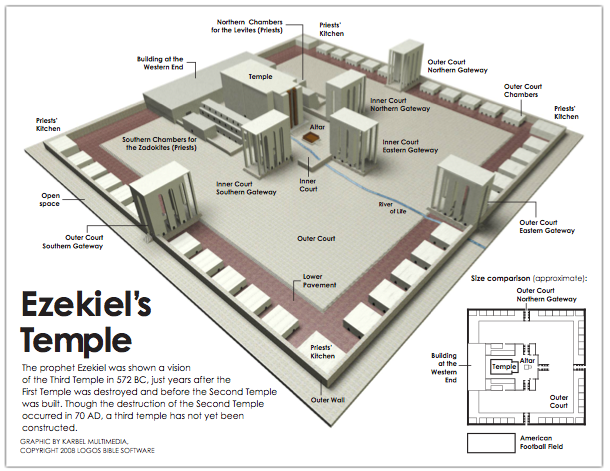
In Ezekiel’s vision, there is no indication of when this Temple would be built, or any indication if this would be the next Temple, the Third Temple, or the final eternal Temple. As you can see from the above dates, when he had his visions, the Temple had already been destroyed, and for anyone reading his prophecies at the time, most would have thought that this was all describing the next Temple – the Second Temple.
The vision of the Temple was given to him as a consolation for the exiled Judeans, that the Temple would definitely one day be rebuilt, even in their lifetimes. Sadly, it was not rebuilt to the specifications of his vision, and it ended up being very modest in size and shape. However, even this fact could be significant, in that it is possible that Zerubbavel did not view Ezekiel’s visions as a blueprint, and so did not feel obliged to build his Temple in accordance with them.
Not the Second or even the Third or Fourth Temple
There are a number of things which suggest that Ezekiel’s detailed description of the Temple is not meant to be taken literally, including the sacrifices. Chapters 40-47 symbolise the consolation that when the Temple is restored, the worship there will be holy and in accordance with God’s will, as opposed to the less than ideal way it was conducted before the exile.
There are a number of things that seemingly suggest that this is a Temple for the far distant future. For example, Ezek 47:7-12 describes riverside and aquatic life that are currently not possible in natural law, so they suggest a description of life when God’s Kingdom is fulfilled in the far distant future. Ezek 47:13-48:29 also describes an idealised map of the distribution of land among the 12 tribes at the time this future temple exists – this seems to suggest that the Temple will only be rebuilt once all the tribes have returned to the Land (Ezek 11:17, 34:11-16). However, the distribution itself is entirely unrealistic and is therefore meant to be symbolic.
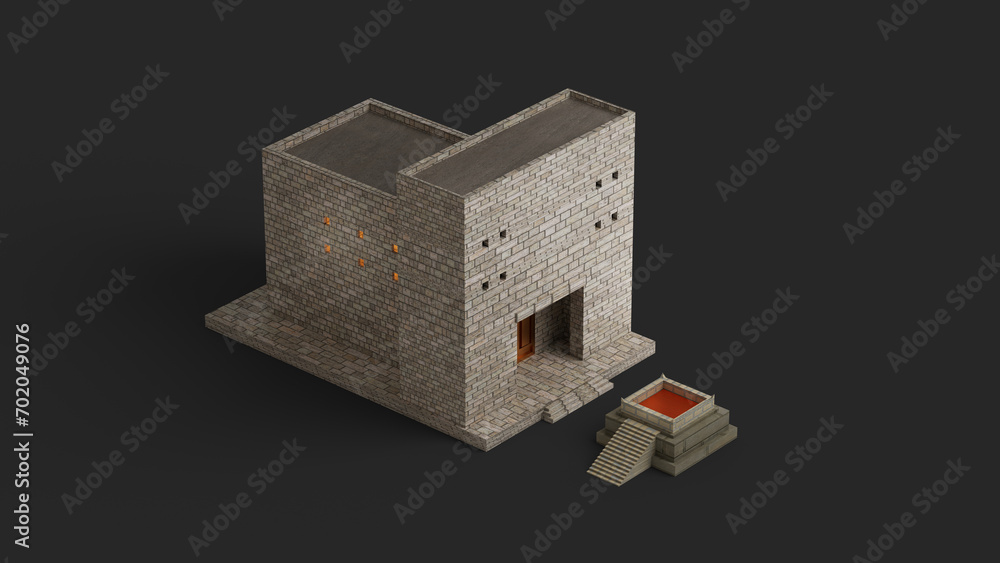
Furthermore, the furniture of the Sanctuary – the ark, the veil, the altar of incense, the menorah, the table of shewbread – these are all completely missing from Ezekiel’s Temple; this is a very important detail to note. The altar of sacrifice also has steps – something that was forbidden in the Tabernacle and Temple. This all suggests to me that everything about his visions of the rebuilt Temple is intentionally idealised symbolism, even the sacrifices, and therefore not meant to be taken as literal (even the description of God’s chariot in chapter 1 is entirely symbolic; every detail in it represents something).
The Prophecies that Supposedly show that the final Temple will have blood sacrifices
There are a number of passages that seemingly say that, when the final Temple is built, the sacrificial system will be included. These passages include:
- Isaiah 56:6-8: This passage speaks of foreigners who join themselves to YHVH, serving God, loving God’s Name, and keeping the Sabbath, and states that God will bring them to God’s holy mountain and make them joyful in God’s house of prayer. It explicitly says their burnt offerings and sacrifices will be accepted on God’s altar.
- Isaiah 66:20-23: This section describes a future time when people from all nations will bring the Israelites as an offering to YHVH to God’s holy mountain in Jerusalem, and that some of them will be taken for priests and Levites. It also mentions that “from one New Moon to another and from one Sabbath to another, all humankind will come and worship before Me,” which, in the context of the temple, some interpret as involving a sacrificial system.
- Jeremiah 33:15-18: This prophecy speaks of a future time when a righteous Branch of David (the Messiah) will reign as King. In this context, the passage states, “Nor shall the Levitical priests ever lack a man in My presence to offer burnt-offerings, to burn grain-offerings, and to make sacrifices each and every day”.
- Zechariah 14:16-21: This chapter describes the outcome of the Day of YHVH, when all the nations that came against Jerusalem shall go up year after year to worship the King, the Sovereign of Hosts, and to keep the Feast of Sukkot. The text implies temple worship is in place, and the Feast of Sukkot in the Torah involved animal sacrifices.
- Malachi 3:3-4: This text mentions that YHVH “will purify the sons of Levi, and refine them like gold and silver, and they will bring offerings to YHVH in righteousness”. It continues, “Then the offerings of Judah and Jerusalem will be pleasant to YHVH as in the days of old, and as in former years”.
I will address all these in my conclusion (which also contains a vital caveat to these prophecies). However, even within rabbinic Jewish tradition, there have been alternative interpretations that lean toward a more spiritual or non-literal understanding of these prophetic passages, or which simply view the cessation of sacrifices as a permanent change in divine worship.
Opposition to Restoring Sacrifices in Rabbinic Judaism
Key interpretations and perspectives include:
- Maimonides (Rambam): One of the most influential Jewish philosophers, Maimonides (12th century), suggested that God only tolerated the sacrificial system in the Bible as a concession to the ancient world’s prevalent mode of worship. He argued that the ideal form of worship, to which the Messianic era would return, is primarily prayer and intellectual pursuit of God, not animal sacrifice. This view implies that the prophecies should not be taken as a literal return to animal offerings.
- Rabbinic Shift post-Temple Destruction: After the Second Temple was destroyed in 70 CE, the emerging rabbinic form of Judaism, by necessity, shifted the focus of Jewish practice. They declared that prayer, charity, good deeds, and Torah study serve as a replacement for sacrifices, a means of “drawing near” to God (the literal meaning of the Hebrew word korban, often translated as “sacrifice”). This established a non-sacrificial model of worship that has been the norm for two millennia, and influences modern interpretations.
- Focus on Universal Prayer: The passage in Isaiah 56:7, “for My House will be called a House of Prayer for all nations,” is often highlighted to emphasise the spiritual and universal nature of the future Temple, where the primary form of communion with God will be prayer, accessible to all peoples, rather than physical animal-offerings limited to a specific place and priesthood.
- Symbolic/Figurative Language in Prophecy: Many Jewish scholars recognise that prophetic literature often uses highly symbolic and figurative language. Visions of future events might be presented in terms familiar to the original audience (like temple worship and sacrifices) but symbolise a deeper spiritual or ethical renewal. The focus is on the establishment of universal peace, justice, and the acknowledgment of God’s Sovereignty, with the specific rituals being an allegorical means to convey these abstract, ideal concepts.
- Rabbi Abraham Isaac Kook: The first Ashkenazi Chief Rabbi of British Mandatory Palestine, Rabbi Kook (20th century), offered an interpretation that only some sacrifices (specifically the Minchah, or grain-offerings, and possibly the Todah, or thanksgiving-offering) would be restored in the Messianic era, while animal sacrifices would not return, aligning with a more ethically refined and elevated spiritual consciousness of that future time.
These interpretations demonstrate that even within rabbinic Jewish thought, there is a range of views on the future of the sacrificial system, moving from a literal expectation (often tied to traditional Orthodox eschatology and Temple Institute activism), to more allegorical and spiritual understandings, prioritising moral and ethical worship over physical ritual.
If a person supports restoring the sacrificial system, they would have to explain what for
Anyone who supports a restoration of the system of blood-sacrifices, would have to explain why – and simply saying that, ‘because God says so’ is not an intellectually or spiritually honest reason.
Blood does not achieve expiation of sin, animal sacrifices do not achieve expiation of sin – it is the Glory of YHVH (the fire of God’s Divine Radiance) which provides expiation for sin. The sacrifices themselves serve no theological purpose, apart from keeping the Israelites away from offering sacrifices to pagan gods, and preventing them from believing that demons cause illness and misfortune. In Ezekiel’s visions, everything there is purely symbolic – you have to look at what everything symbolises and represents, even in the detailed dimensions of the Temple itself, not as a prediction of what things will be. When reading the sacrifices described in his visions, you must look at what the sacrifices symbolise – that’s why they are there. There is symbolic, spiritual meaning even in the detailed descriptions of the sacrifices.
YHVH requires an ethical way of life, not sacrifices
Ultimately, the Hebrew Bible contains passages that emphasise that sincere faithfulness, justice, and a contrite heart are more valuable to God than the mere act of sacrifice when performed without genuine faith or proper moral conduct.
Key passages often cited in this context include:
- 1 Samuel 15:22: The prophet Samuel declares, “Does YHVH have as great a delight in burnt offerings and sacrifices, as in obeying the voice of YHVH? Behold, to obey is better than sacrifice, and to listen than the fat of rams”. This highlights that the moral aspect of a person’s life is paramount.
- Psalm 51:16-17: King David, in a prayer of repentance, says, “For You do not desire sacrifice, or I would give it; You do not delight in burnt offering. The sacrifices of God are a broken spirit, a broken and a contrite heart – these, O God, You will not despise”. This suggests that internal repentance is the most essential offering.
- Hosea 6:6: God states, “For I desire steadfast love [chésed] and not sacrifice, the knowledge of God rather than burnt offerings”. This verse, repeated by the prophet, prioritises covenant faithfulness and an intimate knowledge of God over mere ritual performance.
- Isaiah 1:11-15: God expresses rejection of the people’s numerous sacrifices because their hands are full of blood and injustice, showing that ritual purity cannot compensate for a lack of social justice and righteousness.
- Micah 6:6-8: The prophet asks what YHVH requires, answering: “God has shown you, O mortal human, what is good. And what does YHVH require of you but to act justly, love mercy, and walk humbly with your God?”.
- Proverbs 21:3 directly compares and prioritises ethical action, stating, “To do righteousness and justice is more acceptable to YHVH than sacrifice”.
The types of sacrifices and offerings that would be acceptable in a final Temple, mooted by some Jewish scholars, suggest these future offerings might be only grain or thanksgiving offerings, not blood-sacrifices.
Biblical Passages opposing a restoration of the Sacrificial System
Among Jews who oppose the restoration of animal sacrifices, the arguments are based on several biblical passages (from the Tanakh), and subsequent rabbinic interpretations that emphasise the primacy of moral and ethical actions, prayer, and repentance over ritual sacrifice.
Several key biblical passages are cited in opposition to restoring animal sacrifices:
- Jeremiah 7:22-23 is interpreted by some to suggest that the sacrificial system was not an original command given upon leaving Egypt, but potentially a later but reluctant concession.
- Psalm 40:6-8: “Sacrifice and offering You did not desire – but my ears you have opened – burnt-offerings and sin-offerings You did not require”.
- Hosea 14:3 is seen as a prophetic indication that prayer can substitute for sacrifices, mentioning “Instead of bulls we will pay the offering of our lips”.
- Daniel 9:27: This prophecy states that “in the middle of the ‘week’ God will put an end to grain-offerings and sacrifices”.
These passages contribute to the view in some Jewish movements that moral action and prayer are now more important than animal sacrifices.
Conclusion: What Ezekiel’s Visions are about (hint: it’s not about restoring sacrifices)
The second part of the Book of Ezekiel (chapters 35-48) is about hope, restoration to the Land, and consolation to the exiled Judeans, giving them encouragement that one day, they would return to Judea, and the Temple would be rebuilt in their lifetimes. It is a book filled with symbolism from beginning to end – everything about God’s chariot, for example, is pure symbolism. If instead you take everything literally, you will miss the entire point of the book: the supreme Majesty and Sovereignty of YHVH, that YHVH is both Judge and Saviour, and that God’s plans will be put back on track very soon (i.e. not at some point in the far distant future; if it was, it would be utterly pointless to those Judeans in Exile, who needed restoration soon).
The passages in the Bible that I referred to earlier on (Isaiah 56:6-8, 66:20-23, Jeremiah 33:15-18, Zechariah 14:16-21, Malachi 3:3-4), which seemingly refer to a restored sacrificial system in a final Temple, have to be seen instead in the context they were given – that is, they do not refer to a final Temple. They were all given in the period between the First and Second Temples. Just like the visions of Ezekiel, they would have been seen by the exiled Judeans as referring to the next Temple, not the final Temple.
If Orthodox Jews do succeed in building a Third Temple, and they succeed in restoring animal sacrifices, BUT there is no return of the exiles of the nine tribes of the northern kingdom, there is no divine appointing of a messiah of David, there is no reign of universal peace, no universal knowledge of God, and no pouring out of God’s Glory over all the earth, then whatever number Temple the Orthodox succeed in building will NOT be the promised final, eternal Temple. Just like the First and Second Temples, it too will be torn down, and will not be rebuilt until we, the Jewish people, understand that blood sacrifices are not necessary for expiation, or for a right relationship with God.
If, when the Kingdom of God is fulfilled, and the Glory of YHVH is poured out over all the earth (which can only happen safely when humanity is perfected), then what would be the actual point of sacrifices? Still insisting on blood-sacrifices, even at that time, would suggest a stubborn and wilful refusal to acknowledge something quintessentially central about the very nature of God.